
Whilst helping a friend to trace the genealogy of a family named Mitchell that was primarily based around London and Hertfordshire, I found that an off-shoot of the family involved an Ann Emily Swain who had been born in India but whose forebears were from Long Clawson. Curiosity about a connection to the Vale of Belvoir took hold and I investigated further to find out a bit more about this link between two exotic locations. The story centres on Ann Emily’s father, John George Swain – known as Jack, and his extensive military career.
Jack Swain proved to be a really interesting and fortunate find because quite a few records survive which detail many steps in his life and service.
The Swain family had been long established in Long Clawson. However, John was actually born in Scotland on the 8 July 1876 because his father, also John George Swain, had gone to Edinburgh to study medicine, met a girl there named Ann Lynch, married her and they had John whilst still studying. The family were back in Clawson by the time of the 1881 census, and the boy was perhaps known as Jack to distinguish him from his father.
After school, Jack Swain worked in Melton Mowbray as a draper’s clerk for a Mr Bown, whilst living at 18 Egerton Road. Aged 19 on the 25th September 1895, he joined the militia unit of the 4th West Yorkshire Regiment with service number 3392, attesting in York for a period of 6 years. He clearly took to the military life as, after just 49 days, he transferred to the Depot of the full West Yorkshire Regiment as Private 4482. Before Christmas that year he was made up to Lance Corporal and was assigned to the 2nd Battalion on the 4th April 1896. Seeking overseas adventure, Swain took demotion back down to Private so that he could switch to the 1st Battalion of the West Yorkshires who shipped out to Hong Kong in October 1896. There he gained his 2nd Class Certificate of Education in the December.
Jack Swain regained the rank of Lance Corporal on 27 October 1897 and moved with the regiment to Singapore on the 1 January 1898, and then to the East Indies in January 1899 where he got his 1st Class Certificate of Education and qualified to be an army schoolmaster.. He must have been capable as in 1902 he was transferred to Bengal where he was made up to Sergeant and given a role in the office of the Deputy Adjutant for General Bombay Command. In March 1903 he moved to Bombay.
March 1904 saw Jack Swain transferred to the Corps of Military Staff Clerks and he was appointed Head Clerk Station Staff Office, Nasirabad. He married Aileen O’Reilly, daughter of another Army soldier, in Karachi (reported in the Grantham Journal of 3 Dec 1904) and in 1905 they had their first child, a daughter, Aileen Alice Margaret Swain. In 1906 Swain bought himself out of the British Army – he had served for 10 years and 194 days – and joined the Indian Railway Police, where he worked for several years.
Jack and Aileen had another daughter and three sons, two of whom died in infancy as was common in India in those days (this is pre-Pakistan, of course). By 1907 he was based at Agra in West Bengal, 1,500 kilometers east of his previous base.
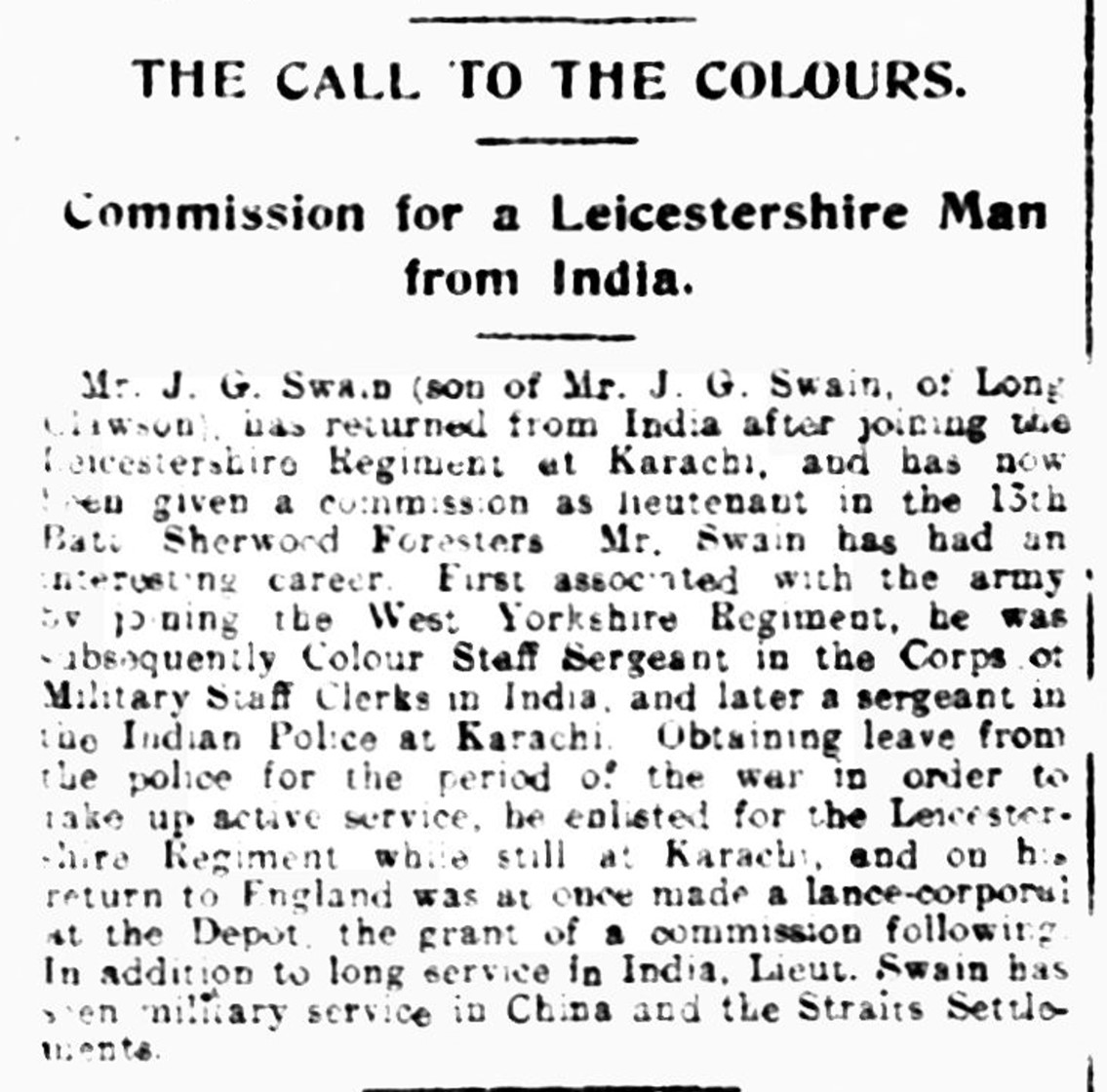
Leicester Daily Post, 1 May 1915
- George Edward Swain was born in Agra on the 27 June 1907 and survived to adulthood.
- Frank Arthur Swain, born in Bombay, died of jaundice aged 1 year and 8 months in Karachi on the 29 September 1910 and was buried the same day.
- Edward Harold Swain was born in Karachi on the 27 July 1910 and had died before 1915.
- Ann Emily Gladys Swain was born on 3 April 1912 in Karachi and survived to later marry into the Mitchell family.
In some of his children’s baptism records Jack Swain’s job is listed as Guard on the North West Railway – but that seems to be more of a security role against attacks on the train than the more administrative role of a guard as we would know it today.
When the war in Europe started, John Swain wanted to serve his country again and took leave from the Railway Police to join the Leicestershire Regiment as a private. He was shipped to England and made up to Lance Corporal at the Regimental Depot. But with his years of experience he wanted a commission, so managed to get appointed in May 1915 as a Lieutenant with the 13th Sherwood Foresters, and was assigned by them to the 93rd Burma Infantry who were being sent to France and who would benefit from an officer used to working with Indian soldiers. In November 1915 he incurred an injury to his knee and spent time in hospitals in Le Havre, London and Portsmouth. In 1916 he returned to the 93rd Burma regiment and they were sent to Mesopotamia. Meanwhile, his wife had another son, Erold Richard, in Karachi in October 1915 but the boy died of ricketts in March 1916, presumably never having been seen by his father.
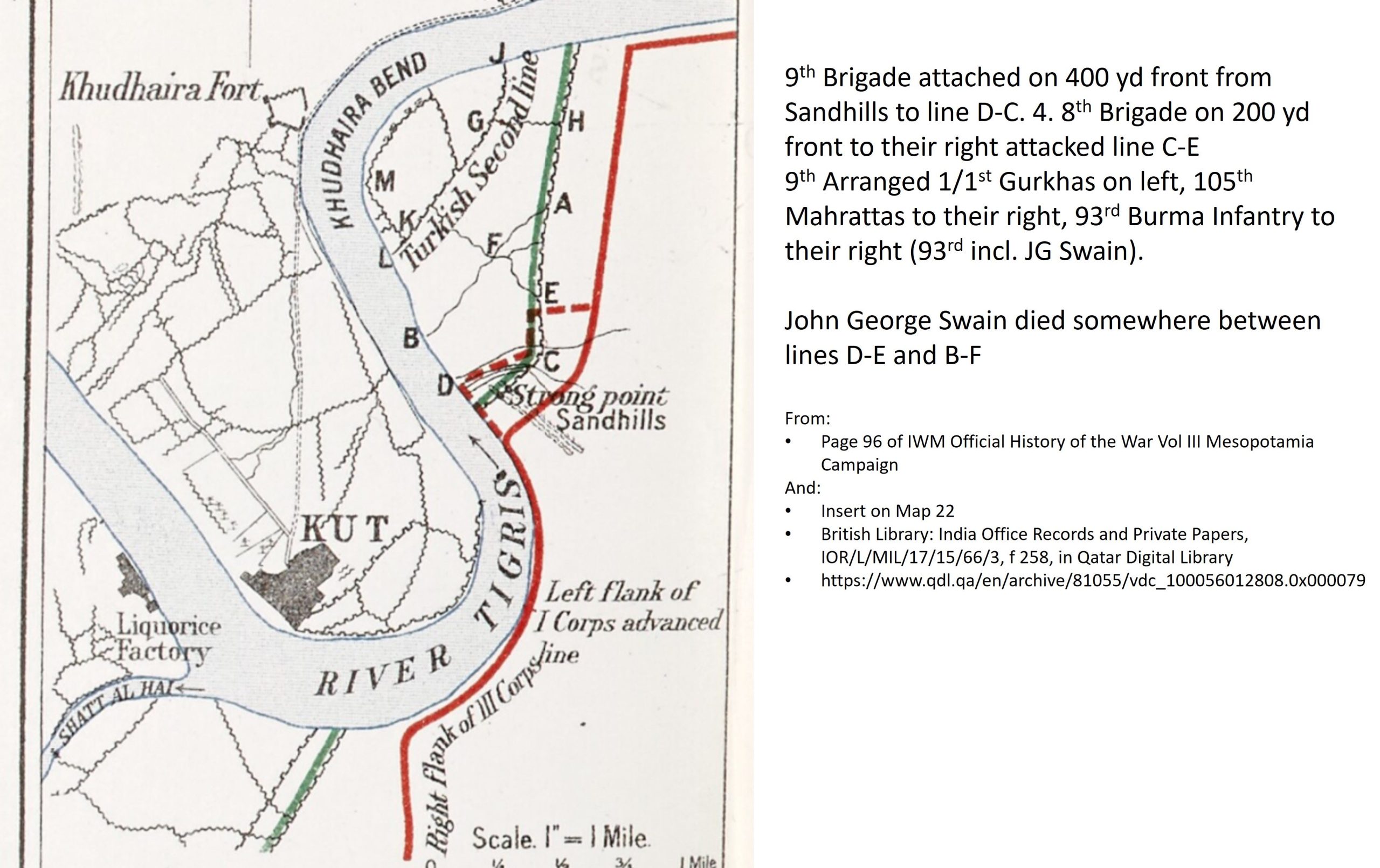
It was customary for men serving in the Army to write their wills which were then held by the local headquarters. John Swain wrote a will on the 1st January 1917 while based just outside the town of Kut-Al-Amara in Mesopotamia. Kut is famous for a British garrison being besieged there by the Ottoman Army from 7 December 1915 – 29 April 1916, at which point they surrendered in an embarrassing loss for the British. Almost a year later, John Swain was there in the force sent to retake Kut. The British force would need to cross the River Tigris northwards to capture the main town and first needed to clear Turkish trenches just south of the river. An attack was launched at a strongpoint in some sandhills at 08:45 on the 9th January 1917 which took the Turks by surprise, although they later counter-attacked and regained some ground. John Swain died during that morning attack.
His Will clearly states that his service revolver and holster were to go to Miss Aline Walpole in Long Clawson, Leicestershire. His clothing and equipment were to go to his sister, Ann Margaret Swain, also in Long Clawson. His money and any other estate went to his wife Aileen in Karachi.
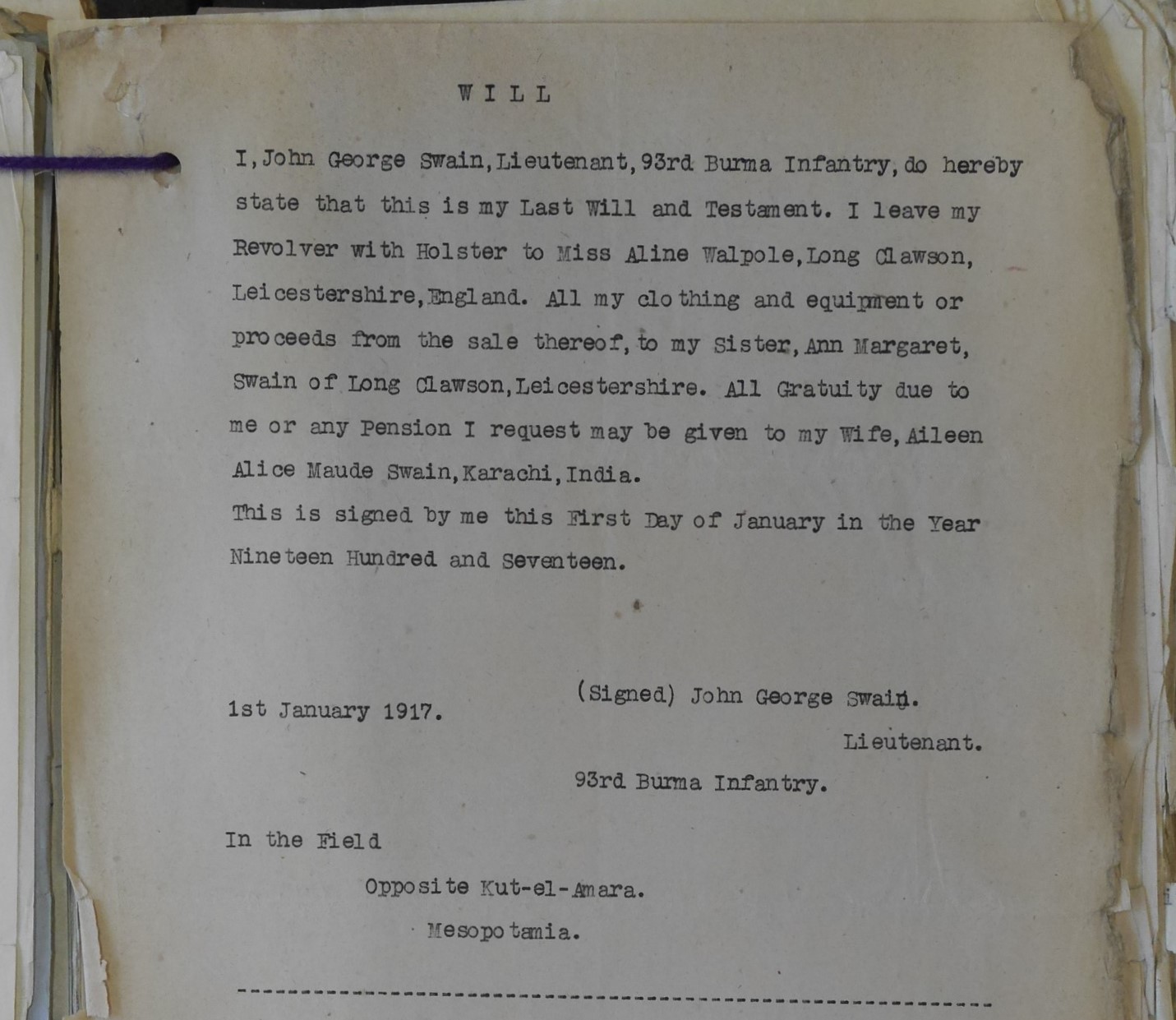
So why did this 40 year old soldier who had spent many years in Asia, and who was clearly still attached to his wife and children, leave a valuable item to a young lady of 26? Who was she and how did they know each other?
Aline Augusta Walpole was born on the 26 June 1890 and in the following year’s census the family lived at 9 Dudley Terrace in East Grantham, so her birth could well have been there. Her parents were Thomas Walpole, born in Ipswich in 1851, and Ada Mary nee Simmons, born in Q1.1853 in Nottingham. Thomas was a machine fitter on agricultural equipment and was on a job in Stanstead, Essex when that 1891 census was taken.
By the time of the 1901 census Thomas Walpole had died (26 Jan 1900) and Aline was in York visiting her great uncle Alfred Walpole, a civil service Inland Revenue collector. Aline was a bright girl and was awarded a Technical Institute scholarship in 1904 after sitting an examination, which put her on a teacher training career path starting with two years pupil-teacher work and education at St Anne’s School which was then on Dudley Road, Grantham, close to where the family lived.
The 1911 census recorded Aline as a school teacher in Coalville, a mining town which lies to the west of Leicester. At some point she must have been transferred to become a teacher at the village school in Long Clawson, some 25 miles to the east. Her employer in the 1911 census was noted as the County Council, so presumably they could move her between schools. She was established in Long Clawson by 1915 for certain, as there are three newspaper posts where Aline is listed raising income for the National Relief Fund. In June this was by arranging entertainment by the Day School pupils; in April and December it was door to door collections around Long Clawson.
So it must have been in 1915 that John George Swain met Aline, because it is recorded that he visited his family at Virginia Cottage, Long Clawson at that time when he was changing from the Leicestershire Regiment to the Sherwood Foresters. This was reported in the Leicester Post in May 1915 (see attached headed Call to the Colours).
A theory could be that Aline perhaps became friends with John’s sister Ann Margaret. When he visited home for a short while they perhaps persuaded him to promise his revolver with the idea that it could be sold to add funds to one of their charitable collections. Or maybe he only thought of that whilst he was in the Middle East. Whatever the case, he was evidently impressed by Aline’s character. Or perhaps they laughed because of the similarity of the name Aline to Aileen, John’s wife back in Karachi.
Finding the will raised several questions:
- was John Swain’s revolver recovered when he died on the battlefield at Kut?
- if it was, did the revolver get sent back to Aline?
- or was it lost in the sands; or taken by the enemy; or kept by a colleague who did not know of the will?
A check with Aline’s descendants did not uncover the answers, though the family were intrigued to learn of the story.
Aline married Frederick Howard Sterling in early 1918. By the 1921 census they were living in Ryde on the Isle of White, with their son Richard and some of Frederick’s relatives. By 1923 they were living at 1 Upper Grotto Road, Twickenham and were there until 1930. In 1931 they were in Holt House, 36 Wensleydale Road, Spelthorne, Hampton in Surrey. Aline still lived at Holt House when she died in West London Hospital in Hammersmith in 1943.
Meanwhile, John Swain’s widow Aileen was left to raise their surviving children, daughters Aileen and Ann and son George. Five years after losing John, she remarried to Frederick John Curtis on the 10 April 1922 in Karachi. They had a further two children there, Myrle Aileen Freda Curtis born 23 September 1922 and Robert Reginald Barfoot Curtis on the 6 May 1924. Eventually they would all leave India, but for places very far apart.
- The younger Aileen married a William Swiney and they moved to Perth, Western Australia where they raised a family. Aileen Swiney died there in 1963.
- Ann Emily Swain (who was the start of this story) married a Robert Mitchell Bailey, an army Staff Serjeant, around the time of WW2 and they settled in Burma. In 1949 they travelled to the UK, first living in Manchester and then moving to Moseley in Birmingham, where Robert made films. Ann died there in 1984.
- George Swain was sent home to England after his father died and can be seen in the 1921 census living with his grandparents in Long Clawson. In 1932 he went back to India to work as a bank clerk and was there through the War. At the end of 1947 he moved on to Kalgoorlie in Western Australia where he married Dorothy Gertrude McDonnell and they had three children. George died in Murchison, Western Australia in 1951.
- Myrle Curtis married a John Divine and they moved to London. Sadly he died in 1950, probably not long after they were wed. She moved to Coventry and died there in 1990.
- Robert Curtis moved to Ulverston in Lancashire where he met and married a Mary Thompson in 1946. They had three children and in 1972 emigrated to Queensland in Australia, where Robert died in 2004.
Frederick and Aileen Curtis came home to England from India after he retired, travelling on the SS Cilicia in May 1948 and initially settling at Ulverston to be near their son. Frederick died in Ulverston in 1953. Aileen lived another 3 years and was in Epsom, Surrey when she died and she was taken home to Ulverston to be buried with her husband.
Back to Jack Swain – In the mess of the 1917 Kut battlefield it seems likely that Swain‘s revolver might have been taken by another combatant or simply lost. His body was recovered, however, and buried, so perhaps another officer would have retrieved his belongings to be sent home. Later his remains were transferred to the Amara cemetery, around 160 km away along the River Tigris. It is a CWGC cemetery (https://www.cwgc.org/visit-
The Melton Mowbray Times published words from his last letter home in the issue of 23 February 1917. It was written to his sister on the day before his last battle:
“- I.E.F. “D” Mesopotamia 8th January, 1917. Dear old Mag, I cannot write at length, as I have not the time. Very busy. Big attack by us coming off tomorrow morning. I am hopping the parapet in the first line. The weather has cleared up a bit, and it is to be hoped that it will continue so until after to-morrow morning, or the going will be much worse than ploughed land after heavy rain, and you can imagine what such land would be to charge over. I feel somehow as if I shall come through and am inspiring my men to the same belief. They are good men and cheerful. If the men at home who are “hiding” could only see what Indian soldiers are doing for them and their homes I think they would be ashamed and come forward. Will write to you when it is all over. Heaps of love to you all, especially George. Your affectionate brother, Jack.
P.S. the reason no parcels are coming up is on account of this push, but they will come up later when transport is available. In the meantime The Cheese!!!”
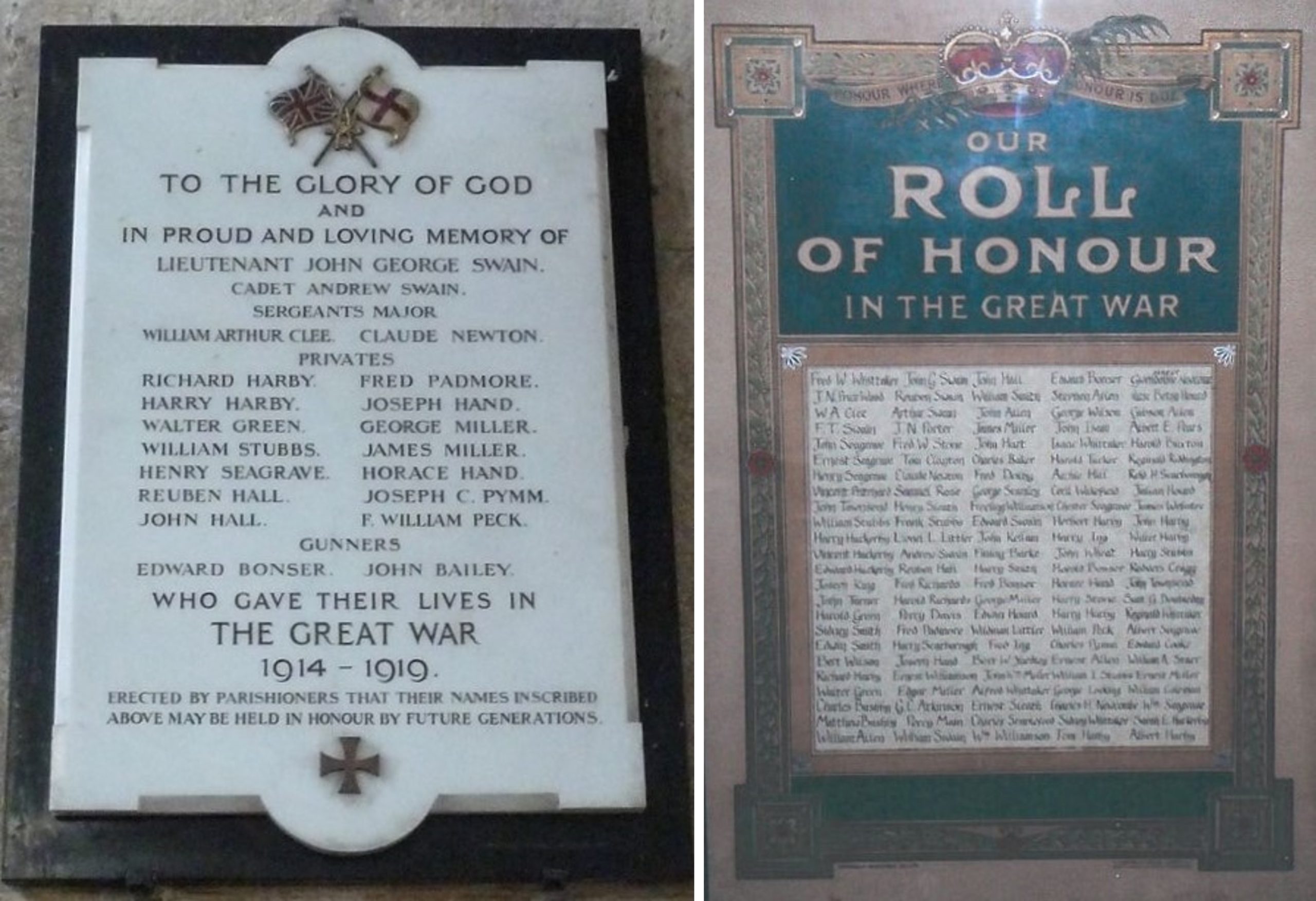
Attached are images of his name on the memorial at the church in Long Clawson, and also on the Roll of Honour which lists all men who served from the village. At the CWGC site there are also documents from when they arranged his memorial and his listing on the National Roll of Honour.
Postscript:
It is worth noting that Jack Swain was not the only member of the family who served in the Great War. His three brothers all joined up, along with several cousins, as can be seen on the Roll of Honour. Edward Swain, born in 1880 in Edinburgh, joined the Army Service Corps with Serial 163164 in late 1915, the last of the brothers to enlist. Frank Taylor Swain, the youngest brother, served as an Air Mechanic 2nd class in the Royal Flying Corps. Both Edward and Frank survived the fighting.
The saddest tale, however, is of Andrew Swain who is shown on the village Memorial to the Fallen, listed beneath Jack. Andrew Swain looks to have wanted very strongly to serve in His Majesty’s forces, perhaps driven by a wish to emulate his eldest brother. But he had a troubled life which was ultimately cut short abruptly on the very last day of the War.
His parents had moved back to Leicestershire at the end of 1880, so Andrew was born in Clawson on 26 April 1881. After school he became a commercial clerk in Nottingham, living in lodgings on Carrington Street. Letters coming home from his successful brother in the Indian Army may have been the spur for him to enlist in the Royal Navy in 1902. His service record shows that he began with induction at HMS Victory I in Portsmouth between 14 October and 5 November 1902. He was assigned to be a Probationary Sick Berth Attendant at Haslar Naval Hospital and after a Very Good character rating was made up to full Sick Berth Attendant on 4 March 1903. He was assigned to HMS Duke of Wellington I, an old hulk of an ex-line battleship then being used as accommodation. In 1904 he worked again at Haslar Hospital and then at Portland Hospital until 22 February 1905.
There followed a period of serving on active ships of the Home Fleet, still as a Sick Berth Assistant. HMS Fire Queen from 23 Feb – 7 Mar 1905; HMS Goliath from 8 Mar – 1 May 1905; then HMS Exmouth from 2 May – 18 Jul 1905. The shortness of these posts may have been routine, but they seem to indicate that Andrew Swain did not readily fit in with life at sea. He returned to shore, working again at Haslar from 23 July to the end of August, but the Navy did not find him a good fit, as shown by this report put on his record on 25 August: “Approved discharge, services no longer required, he being weak both physically and mentally, his general behaviour such as to have a bad effect on the men with whom he is associated”. He left the Navy on 3 September 1905.
Andrew returned to working as a clerk and in April 1909 he married Nellie Lowe who was from Bitteswell, a village south of Leicester. Their son Gordon Frank Swain was born on 2 June 1910 in Leicester. Andrew’s job took him away to work, the 1911 census showing him as an accountant’s clerk boarding in Toxteth, Liverpool whilst Nellie and Gordon were boarding in Leicester. The family later moved into rooms in Mecklenburg Street in Leicester owned by a Mrs Collis, but the marriage was not in a good state.
Before the Great War, Andrew had joined the South Nottinghamshire Yeomanry and was with them for three years, presumably part-time. On the 22nd March 1915 he attested with the Leicestershire Yeomanry, joining as a Private in the 3rd/1st Battalion, Serial 2905. He stated on the Attestment Form that he was married, though details of his wife are missing, and whilst he mentioned his previous yeomanry experience there is no mention of his Royal Navy service. His medical record shows that he weighed just 7 Stone 10lb and was 5ft 5in in height, but was pronounced fit to serve. On the 28 April he was made up to the rank of Lance Corporal and on 15 June he transferred with the same rank to the 2nd/1st Battalion. On 17 April 1916 he was demoted to Private, but a year later he was put back to acting Lance Corporal and that was made permanent on 12 October 1917.
Meanwhile it is apparent that his marriage had disintegrated. The Leicester Chronicle of 29 May 1915 reports Mrs Collis having Swain summoned for behaving in a disorderly manner at her home on 18 May. He was reported to be living apart from his wife and had gone to the Collis property to try to see his son. “There was much bad language in the street and the police were sent for.” Swain was bound over to keep the peace for six months.
Andrew Swain tried to improve his lot and managed to get assigned to an officer commission training course even though he had no experience out of England in wartime. In January 1918 he was assigned to Jesus College, Cambridge in the Garrison Officer Cadet battalion. This fresh start sustained him for a few months, but his physical and mental state again started to let him down. At a medical board in Cambridge 1st Eastern General Hospital on 16 May 1918 his fitness was deemed Class E, with the note “Disability – Neuritis – Piles – Poor Development”. On 22 June 1918 he was ranked as being no longer physically fit for War Service under paragraph 372 XVI Kings Regulations.
A few weeks later he caught influenza – the Spanish Flu pandemic had reached England – and unsurprisingly given his weak physique it developed into pneumonia. Cadet Andrew Swain died in a military hospital in Camberwell, London on 11 November 1918.
- War Offices records at The National Archices – WO 339/500 Service Record of Lt John George Swain and ADM-188/531/351145 record of Andrew Swain.
- Items from the Grantham Journal, Leicester Mercury, Leicester Daily Post and Leicester Chronicle, via Newspapers.com and British Newspapers/Family Tree Maker.
- BMD, Military and Census records at Ancestry.com
- Thanks also to Lee Richards at Arcre Research for copying Jack Swain’s Service Record

Comments about this page
Hello Bill, thanks for adding this detailed and painstaking piece of research to our website. The result is a fascinating account leading up to Jack’s death in the sands of the Tigris at Kut. What a waste of a life. Then the story of Andrew Swain and his much sadder life and miserable end dying of flu right on the 11th November 1918. You bring home the waste and futility of it all. Neil
Add a comment about this page