
James Monks: a tragic death on the railway in 1887
A headstone in Bottesford churchyard
Neil Fortey
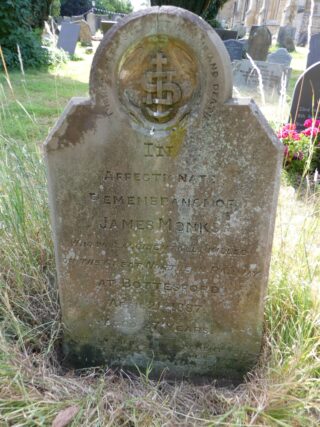
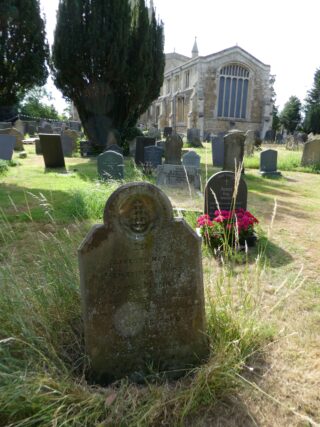
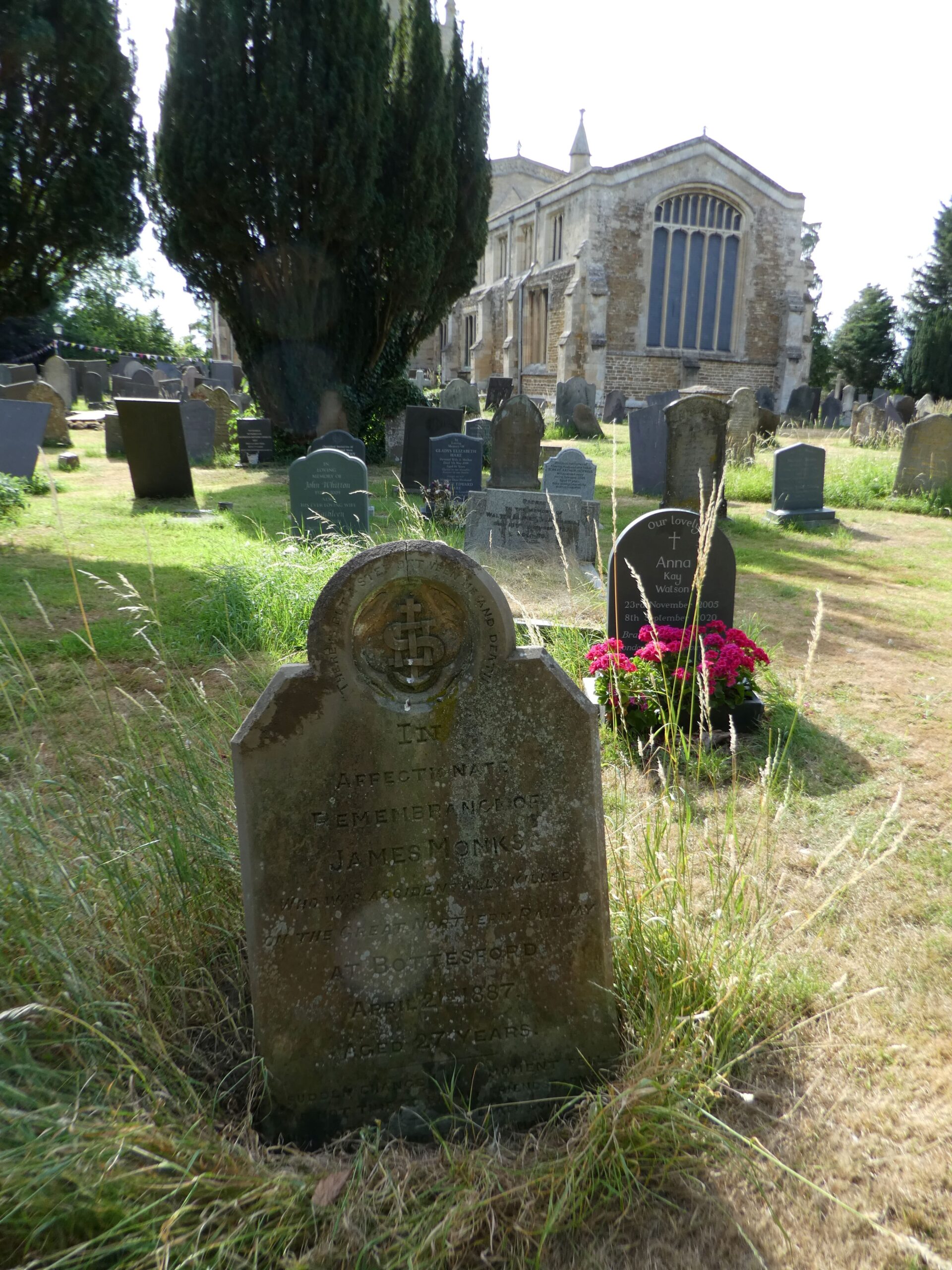
Our friend Lydia Spenceley mentioned the headstone marking the grave of James Monks, who was killed on the railway on April 21st,. 1887, and asked what I knew about it. I had to admit that it had been overlooked in the recent study of the history of Bottesford station.
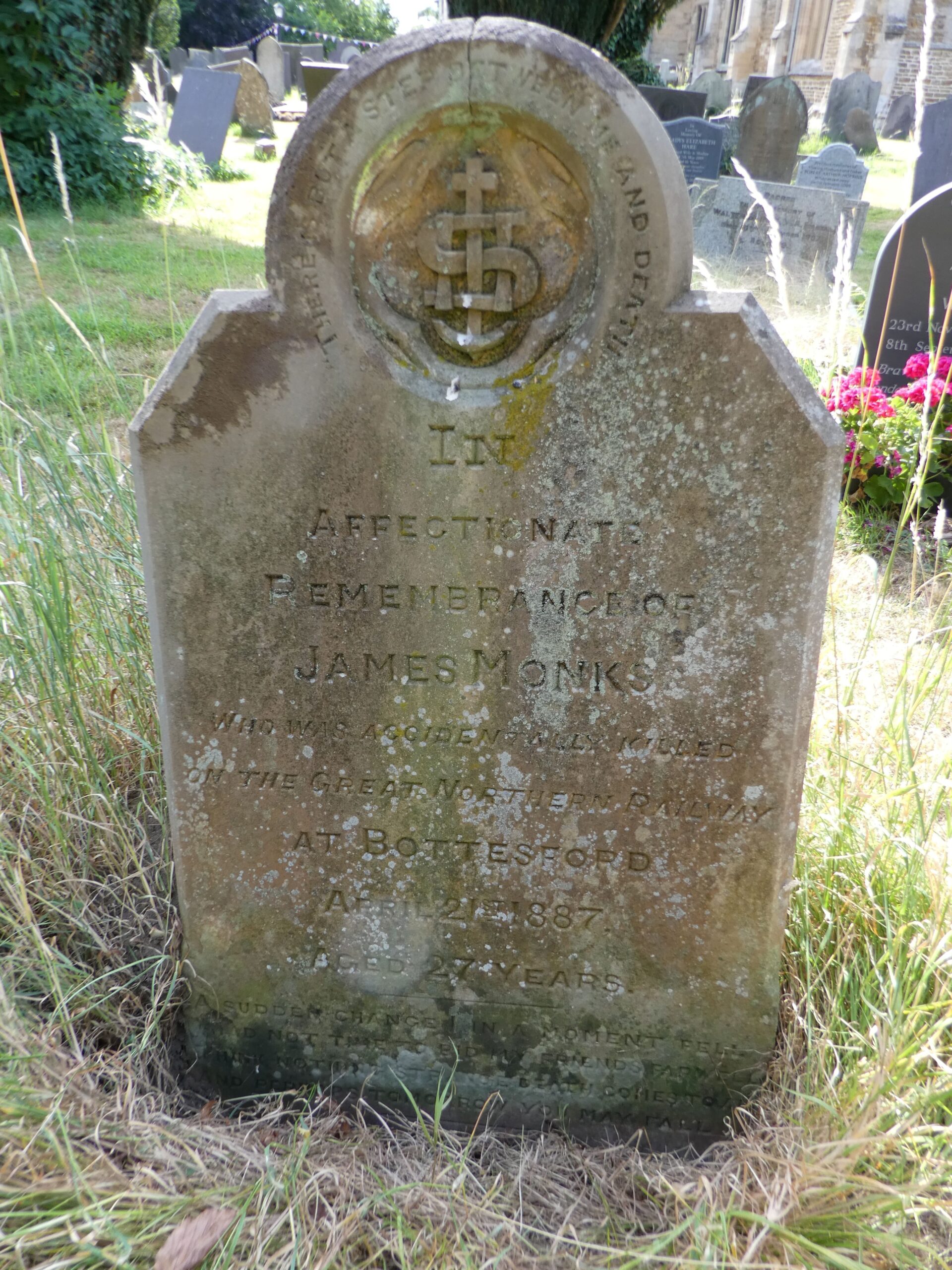
The words on the stone read, “In affectionate remembrance of Jame Monks who was accidentally killed on the Great Northern Railway at Bottesford, April 21st 1887, aged 27 years.” There is no mention of his family and the words “affectionate remembrance” rather than “loving memory” feel rather formal to me, a little odd.
The roundel forming the top of the stone carried the morbid caption, “There is but a step between me and death”. At the base of the stone are the words, “A sudden change I in a moment fell and had no time to bid my friends farewell. Think nothing strange, death comes to all and perhaps tomorrow you may fall”.
It feels as if his funeral and the headstone might have been paid for by his employers, the GNR. Perhaps his family were too poor to meet the expense, perhaps they had pre-deceased him leaving no family members to be present at his funeral.
In the National Burial Index his age is given as 26, his birth year 1861.
In the 1861 census we find that he was living in his mother’s household at Wright’s Row, Bottesford. Ann Monks was a 36 years old charwoman originally from Shelton, Nottinghamshire, where she was born in 1824, daughter of James Monks (Snr). There were six children in the small cottage: James was the sixth, still a baby less than a year old named after his grandfather. The others were William aged 18, Thomas 11, Jane 9, Mary 6 and John aged 4.
James’s father was John Monks, who appears to have been baptised in Redmile in 1820. He married Ann Mellows in St Paul’s, Nottingham, on the 23rd December, 1850. His death in the second quarter of 1861 was registered at Newark, leaving Ann widowed with five children to look after and another on the way.
Ann Monks, nee Mellows, married William Harvey, 39, in Bottesford on the 4th November, 1862. The marriage certificate confirms that that he was a widower and that she was a widow. In the census of 1871 James, aged 10, is described as a “farmer’s boy” living with his step-father, 49 years old William Harvey a gardener from Granby, and his mother Ann, 47, from Shelton.
I also searched the 1881 census but found nothing about James in the Bottesford area. He was almost 20 by this time and must have.
The Melton Mowbray Times of April 29th, 1887, reported on the inquest held at Bottesford Station into James Monks’ death, stating that he was a platelayer who was hit from behind by a Leicester-Grantham express train. The main witness, Henry Bailey, said “I live at Bottesford and am foreman platelayer on the G.N.R. I have known the deceased for many years. He was 26, a platelayer on the GNR and L&NWR Joint Lines at Bottesford. I identified the body. He was carrying lamps from the south junction box to the signals, and on Thursday the 21st he was engaged in that duty. It is contrary to the rules to walk either in the four-foot or the six-foot of the railway. I heard the engine whistle before reaching the junction signal before Bottesford Station.”
William Pearl, engine driver, said that the train was due to pass Bottesford Station at 5.7 pm. He saw a man in the four-foot of the down line walking in the direction of Bottesford Station. He added, “I whistled continuously”. From these details it appears that James was walking northwards along the line, between the rails, as the train was approaching from behind him. William Brooks, fireman, added that the man took no notice of the whistle, probably 100 yards in front of the engine travelling at about forty miles per hour.
However, PC Heggs from Stathern was a passenger on the train and said he heard no whistle.
Bottesford surgeon Dr Frank Marsh wright said the man was quite dead, fearfully injured. The verdict was given as accidental death.
What a sad story. The inquest established the main facts, but there is still the unanswered question of why James Monks did not move out of the way. It seems he was walking northwards towards the junction box and Bottesford station, and the train approached from behind him. There was some question as to whether the whistle was actually sounded, but even if it was not an experienced railway man such as Mr Monks would have known that the express train was approaching him and yet he did not get out of the way.
It seems that we know what happened but we do not know why. Under the circumstances, the verdict of accidental death is understandable. If James Monks’ emotional state and personal circumstances had been revealed then we might understand better, but this is no more than idle speculation, especially now over a century later.

No Comments
Add a comment about this page